A talking mascot that teaches the 12 principles
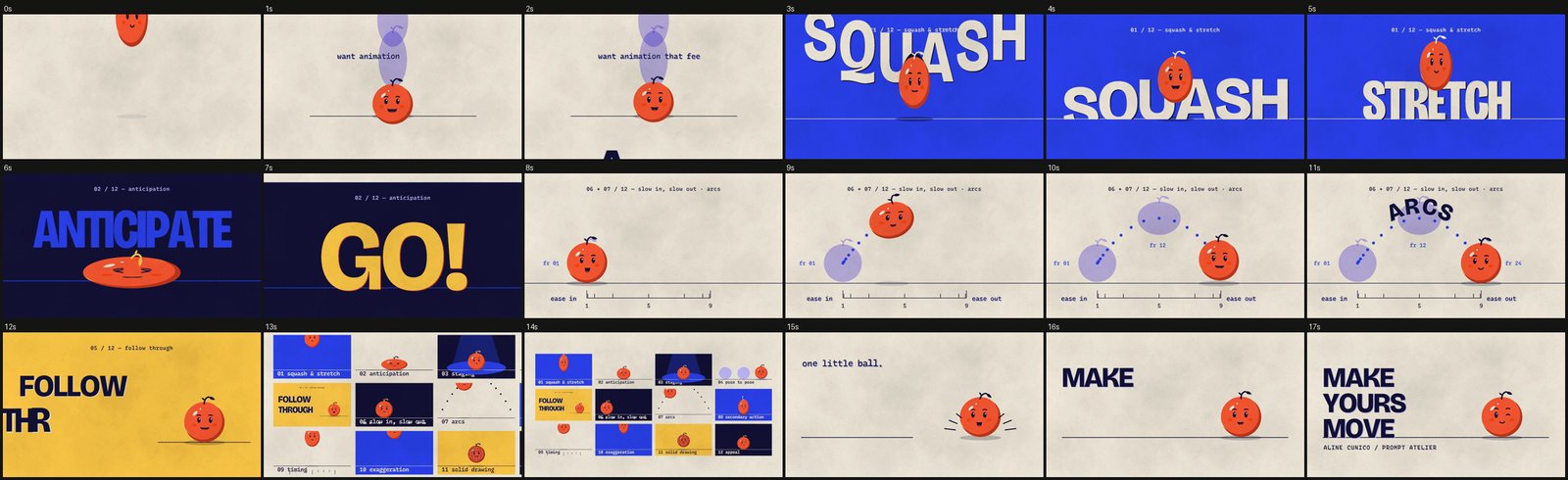
An 18-second explainer made entirely in code with Claude: an original character, lip-synced to an ElevenLabs voice, cut to a Suno track, with type that obeys the physics it names. Here's the short version of how.
Five steps
The idea came from a talking-mascot explainer I saw on X: a voice plus a character that explains the product. I kept the grammar (a mascot, words landing beside it, a new picture every couple of seconds) and made everything else my own.
Brief a character, not a style
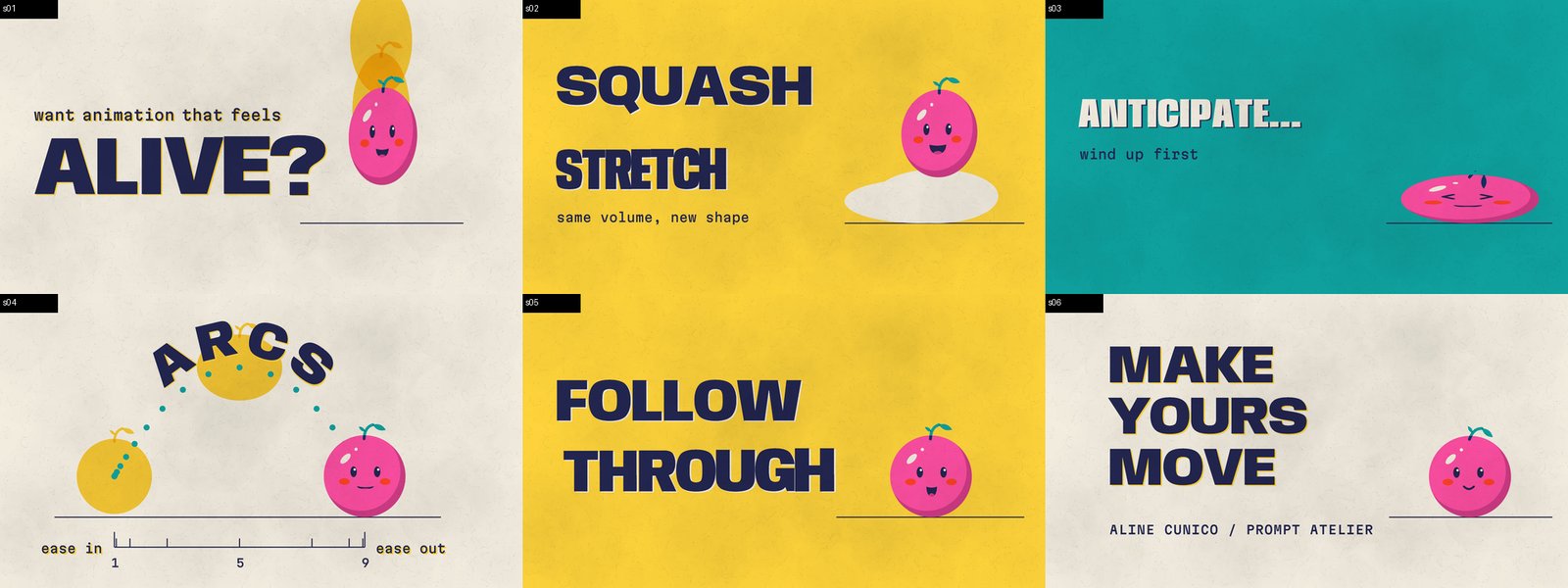
The character is the lesson. The bouncing ball is the first exercise every animator does, so Pip is a ball with a sprout on top: squash and stretch happen in their body, and the sprout shows follow-through.
Use the motion-studio skill. Make a 15-second video about how to make amazing animation, mentioning a few of the 12 principles. A talking character explains it; the character and the style must be completely our own, not the reference's. Before you start, tell me the plan, what you need from me, and write the script. Make it incredibly visual and beautiful.
Fit the film to the voice
I generated the voiceover in ElevenLabs from Claude's script, with <break> tags for breathing room. It ran 16.8 seconds instead of 15, and that was fine: Claude measured the pauses and syllable peaks, re-timed every shot to the voice, and drove Pip's mouth from the audio itself (loudness for how open, brightness for "ee" or "oo").
API keys live in .env; the prompt only ever says "the key is in .env". Never paste a real key into a prompt you'll screenshot.
Let the music set the clock
A Suno track at exactly 120 BPM, cut to the film: the drop lands on Pip's first splat, a beat-exact splice opens the finale on a fresh bar, and the song's button ending lands on the word "move". The foley (splat, squeak, wind-up creak, whip, pops, a wink) is synthesised in code, every sound on the frame of its hit, and the music ducks 9 dB under the voice.
Ask for a senior critique
The first cut worked, but it looked basic and I didn't love the colours. So I asked for a critic:
I don't love the colours, and it still looks a bit basic. Act as a senior motion graphics designer making a reel about animation for a big agency, and improve this by a lot.
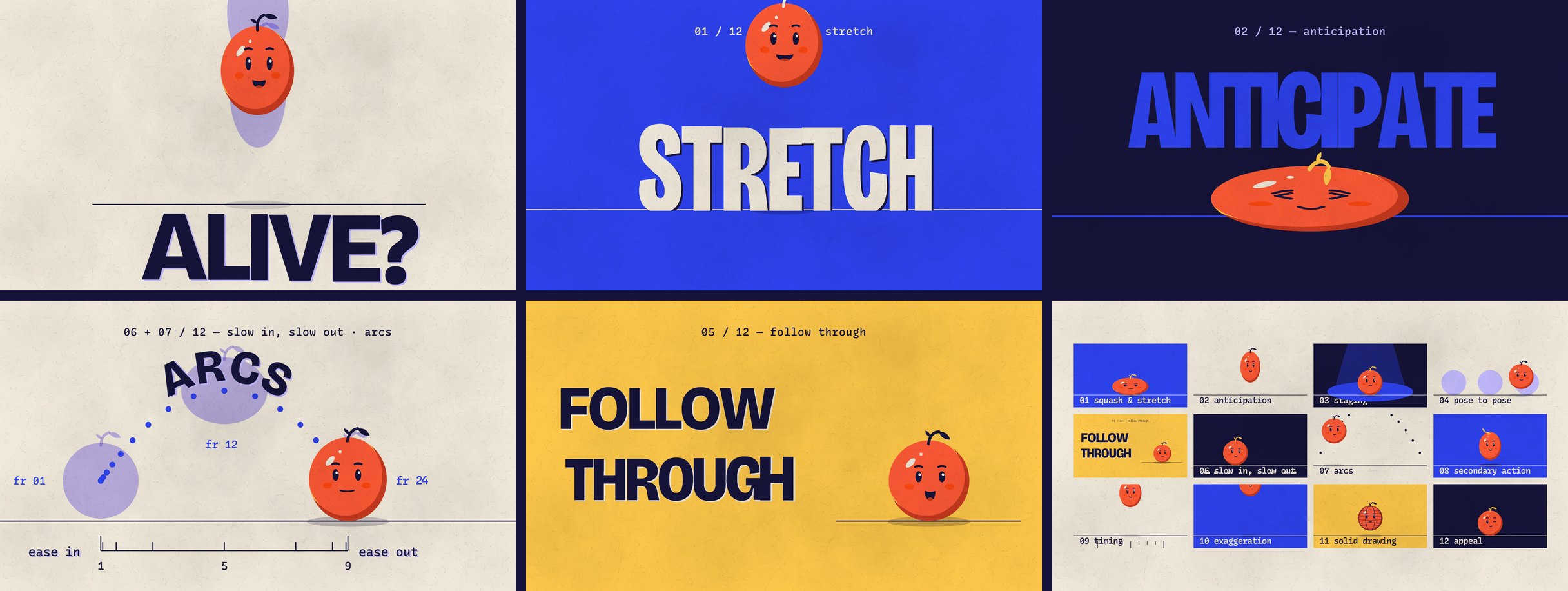
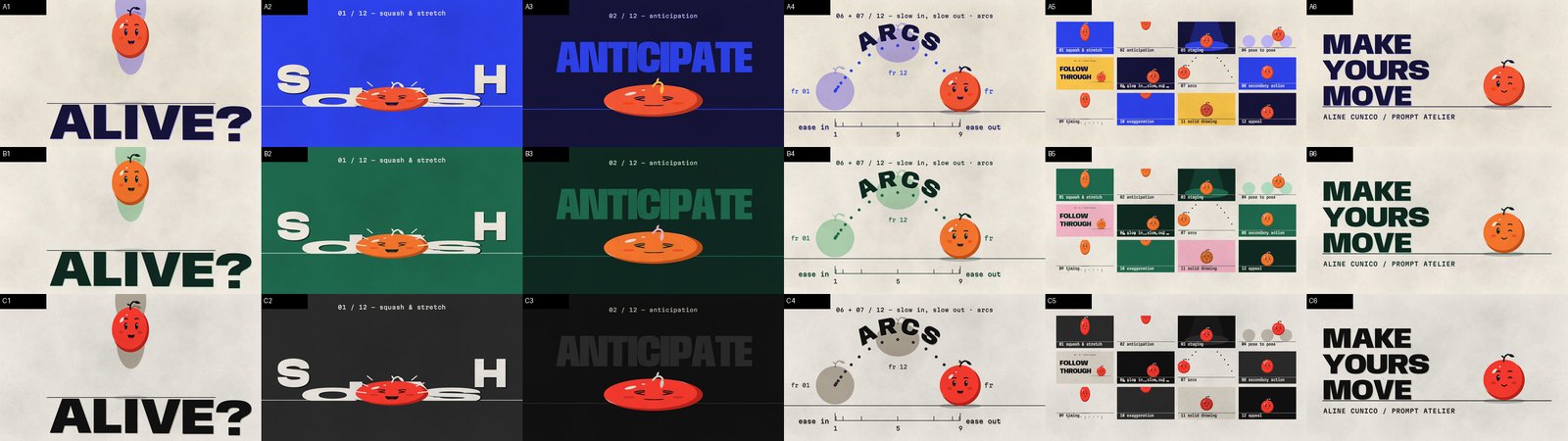
Claude's diagnosis: the same layout in five of six shots, candy colours, a character that read like a sticker, no design system, and a small payoff. The fixes: big type behind Pip that obeys its own principle (SQUASH falls and squashes, STRETCH shoots up, ANTICIPATE winds tighter), a numbered series ("01 / 12 — squash & stretch"), eyebrows, smears and shadows for Pip, a grown-up palette, and a finale where the follow-through shot turns out to be tile 05 of a grid of all twelve principles.
film.json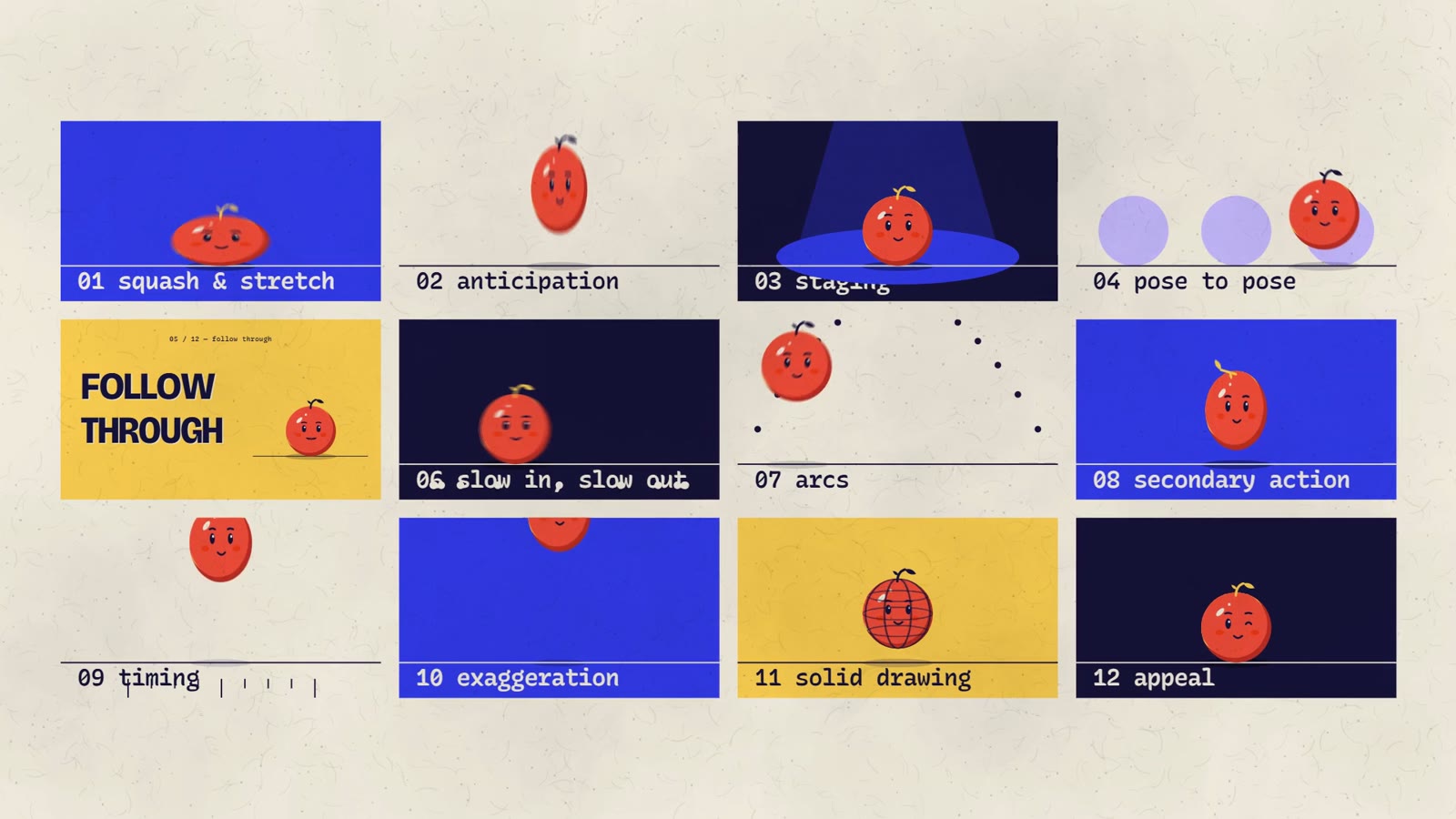
Render, then check every frame
Only after approval: a 60 fps master with motion blur measured per frame, then the checks. 0 frames blending two shots, loudness −14.1 LUFS, every word readable on a 360-pixel phone sheet. On a 3.7 GB laptop the parallel render ran out of memory; one job at a time and a cap of 8 blur samples per frame finished it in 23 minutes.
Credits
- Idea: the talking-mascot explainer by achxvi (the Pocketsflow version), seen on X. Grammar only; the character and style are original.
- Voice: ElevenLabs. Music: "One Big Boing", generated in Suno; usage rights depend on your plan.
- Fonts: Bricolage Grotesque and Recursive, both SIL Open Font License 1.1.
- Method: the motion-studio skill, built on Movez's How to build motion design studio with Opus 5.5 and the RoboNuggets storyboard workflow (full credits on the motion reel tutorial).
- Tools: Claude Code (Opus 5.5), Playwright, ffmpeg, librosa. The lip-sync is plain loudness and spectral analysis of the voice file.